

Media Strategist
Defines channel selection rationale, media mix principles, and flighting structure as upstream strategic input to your Media Plan.
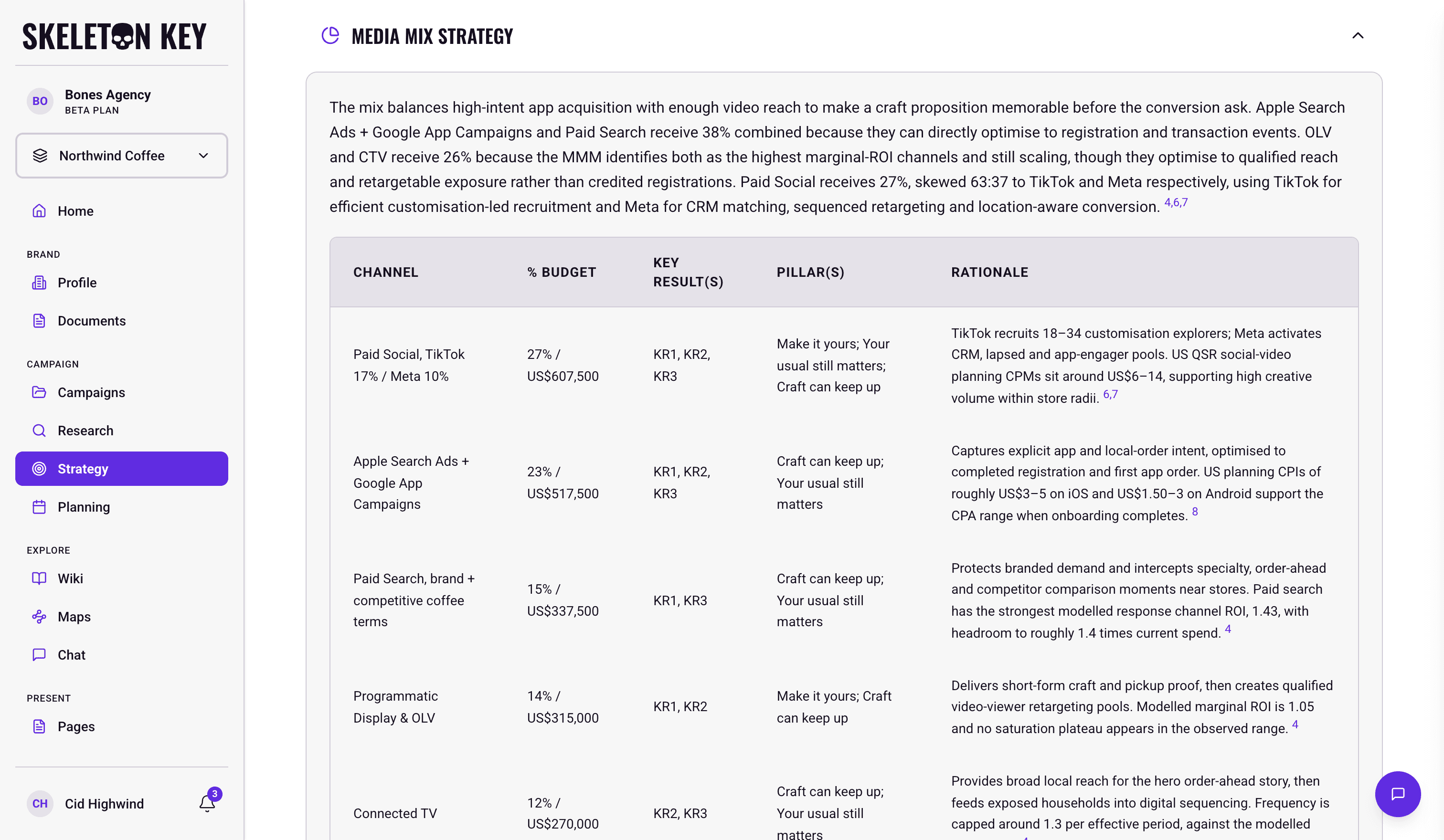
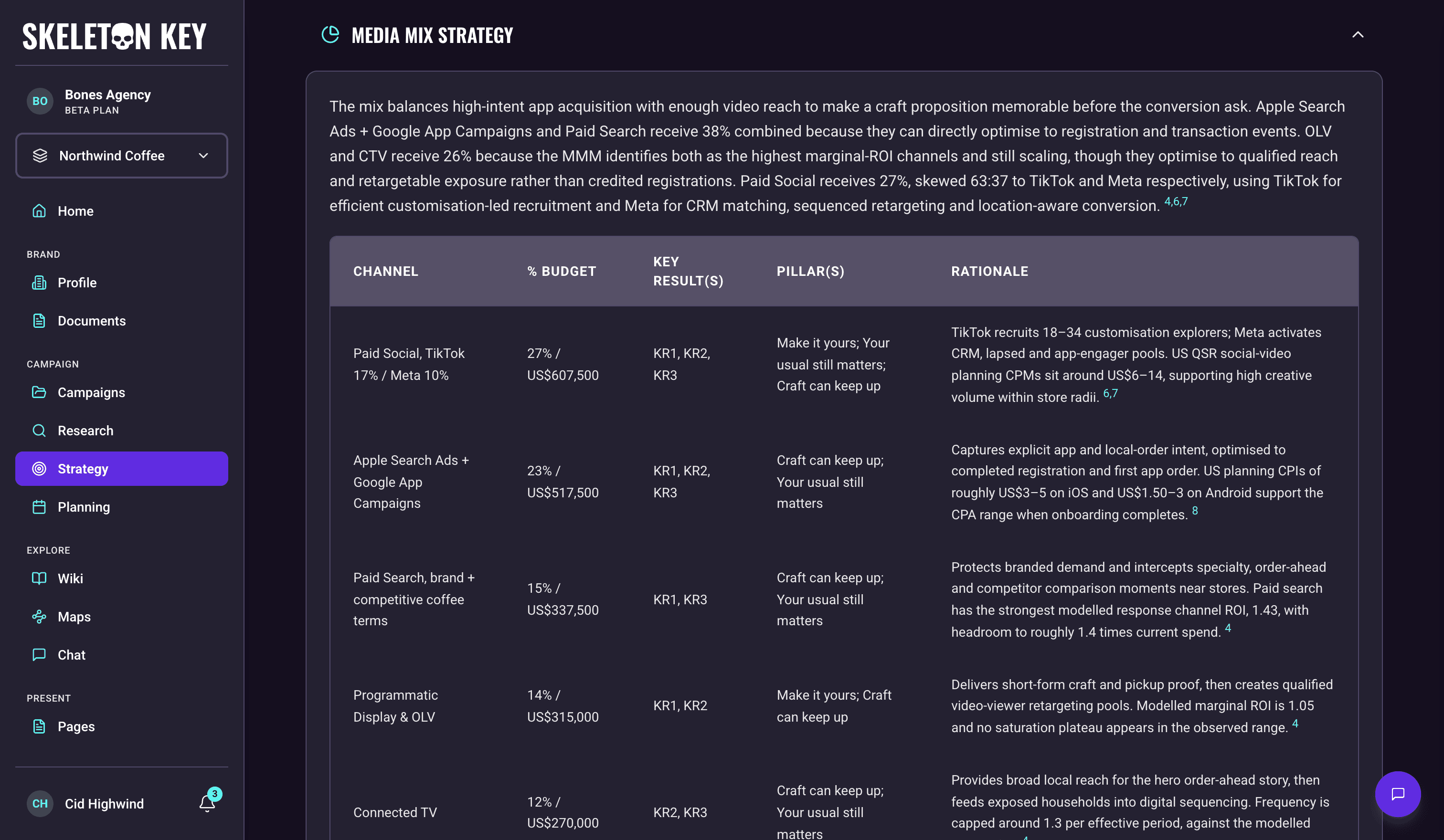
The Media Strategist is the fourth strategist in the Strategy phase. It reads Goals, Audience, and Communication outputs, then defines which channels carry which message to which audiences, and why.
Media Strategy vs. Media Plan. Media Strategist defines the what and why: channel rationale, allocation principles, flighting structure. The Media Plan delivers the how and when: schedules, frequency caps, bidding, and variants. Strategy comes first. The Media Plan consumes it.
What it does
Media Strategist produces a paid channel mix and the strategy that supports it. It opens with an Executive Read on the plan's central tension and how the budget splits across channels and markets, closed by a Foundations list of the campaign's focus, budget, dates, markets, Objective, Key Results, personas, and pillars. The core output is a channel allocation table: each channel mapped to a budget %, a primary KR, the Communication pillar(s) it carries, and a strategic rationale. Paid channels sum to 100%. Owned and earned channels get their own table with a role and a paid-synergy note instead of a budget share.
Flighting makes two calls: the flight structure (a single push, a sequence, or overlapping flights such as an always-on baseline with a burst layered on top) and the weighting pattern (even, front-loaded, mid-peak, back-loaded, or pulsed). Each flight gets its own dates, budget, and daily spend. The week-by-week calendar belongs to the Media Plan, not here.
Around the channel mix, the strategist produces a set of creative levers under one organising idea, targeting guidance per Audience persona (which signals to weight), a measurement plan that starts from the measurement method Goals set for each Key Result and names the platform and study, with per-KR baselines and target lifts, and a Risk & Mitigation table.
For multi-market campaigns, a Geo table gives each row of the Research Market Prioritisation table its own line (less any rows merged or dropped with a stated reason), with a budget weight, a role, and a strategic emphasis, at the level Research listed them (countries, regions, or cities). Places Research grouped into one row share that row's budget. If you name a broad region, Research may divide it into up to three markets when that sharpens the strategy, or keep it as one.
Where to find it
Navigate to Strategy inside any brand or campaign (Research must be complete). Media is the fourth of four strategist tabs.
How it works
The strategists run in order: Goals, Audience, Communication, Media. Media reads the Goals KR table, Audience personas, and Communication pillar names verbatim. It also reads the brand profile, campaign brief, and Research outputs, and when a Research report leaves out a figure, period, or source, it can look up the search findings stored behind the Category, Competitor, Consumer, and Culture reports. Attached documents are processed first. Web research fills gaps, capped at seven calls (the largest research budget of the four strategists).
For multi-market campaigns, each Research market row gets at least $10K. A row that would fall below that is merged with its closest row, one in the same country first, and the output says which rows were merged and why. A shortfall no merge can fix is flagged in the Risk & Mitigation table.
The full Strategy run takes around 7-8 minutes, and Media Strategist contributes about a minute.
What you can adjust
Campaign brief: A stated budget and geo scope give the strategist what it needs for a defensible channel mix. Under-specified budgets produce directional allocations.
Document attachment: Media briefs, past debriefs, or agency channel frameworks feed directly into channel selection rationale. So do the results of a completed Marketing Mix Model run, saved as a brand document. Attach it and the channel mix is grounded in each channel's measured return.
Refine: Refining Media re-runs only this strategist. Refining Communication or Audience may trigger Media to re-run too. Prior versions stay in history. See Refine.
Limits and considerations
- Channel benchmarks lean on web research. For non-Western or niche-vertical markets, benchmarks may be sparse or dated. Validate against agency or platform data before committing budget. Attaching agency frameworks or media briefs from the Documents page brings them into the strategist's input.
- No tactical execution detail. Frequency caps, bidding strategies, and production timelines are excluded. Those belong to Media Plan.
- Geo decomposition follows Research. The per-market split covers the markets in the Research Market Prioritisation table. Markets outside it are not modelled.
- Pillar names propagate verbatim. Refine Communication first if you want to change pillar names, then re-run Media.
- Beta software. Outputs are not infallible. Validate channel mix and flighting logic with your media team before briefing executional partners.
Last updated: 2026-11-02