

Goals Strategist
Translates business objectives into measurable marketing goals.
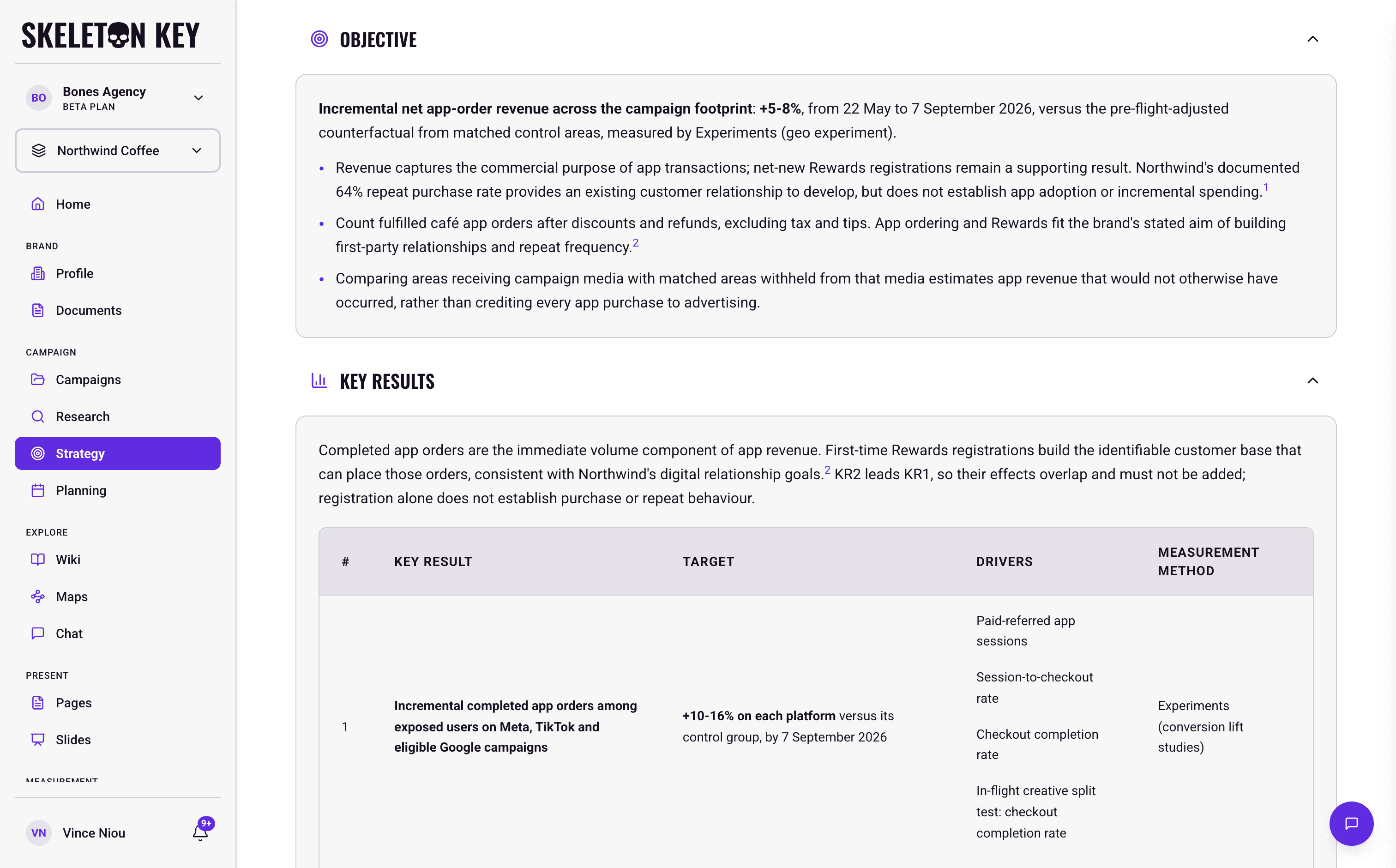
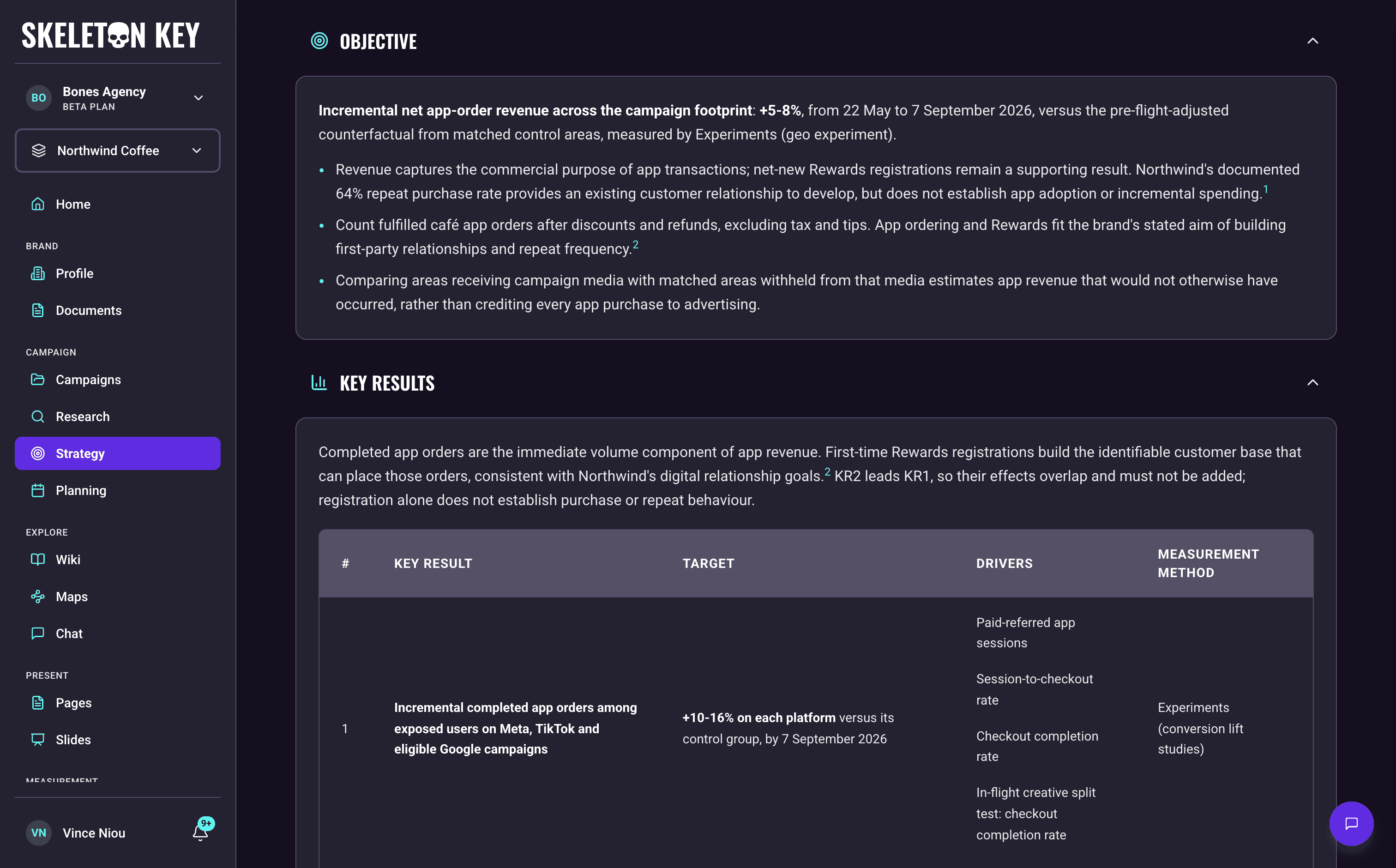
The Goals Strategist is the first of four in the Strategy phase. It turns your campaign objective into one Objective with two or three numeric Key Results, each with the metrics that drive it. The three strategists that follow all build on what Goals produces.
What it does
Goals builds a metric tree: one Objective, two or three Key Results that lead to it, and the drivers that move each Key Result. The report opens with an Executive Read covering the Objective and its target range, why these Key Results, which measurement methods the budget can support, and the condition the targets most depend on.
The Objective section opens with one line: the metric, its target range, the date it's due, what the target is compared against, and the method that will measure it. One or two bullets follow on why the metric fits your brief, each citing its evidence. Where that method is causal, the metric reads as incremental lift, and a further bullet explains how the method shows the campaign's true effect on the business.
The Key Results section opens with a short paragraph on how the Key Results lead to the Objective, then a table with one row per Key Result, ranked by how much it contributes to the Objective, with columns for Key Result, Target, Drivers, and Measurement method. No Key Result restates the Objective. Drivers are the delivery, engagement, or site metrics reported during the flight that move the Key Result, such as reach, frequency, click-through rate, or conversion rate. If your Objective is incremental sales, for example, a Key Result might be incremental purchases among people who saw your ads on one platform, with paid sessions and conversion rate as its drivers.
Target ranges are always numeric. When the brief names a specific target (e.g., "+10% purchase intent"), the strategist anchors a range around it (e.g., "+8-12%"). With no target specified, it derives one from attached documents, then Research outputs, then industry benchmarks.
A closing Validation Checks section tests the tree. Achievability asks whether the budget can pay for the Objective, against media cost and conversion benchmarks, and against what the category is doing. Alignment asks whether each Key Result adds up to the Objective and which are leading or lagging indicators. Causality asks whether each part is measured by the strongest causal method the budget allows, and flags any channel whose likely budget falls short of its study's entry minimum. Risks names what could limit the results: a blind spot in how the Objective is measured, evidence gaps, study eligibility, and measurement costs above a tenth of the campaign budget. Achievability, Alignment, and Causality each open with a direct yes, partly, or no. The Objective bullets and the Key Results paragraph cite the evidence behind each choice. Benchmarks and caveats sit in Validation Checks.
Goals also determines a strategic focus category, written to the campaign record. The other strategists use it to orient their outputs. It's not visible in the Goals output, but it shapes everything downstream.
Where to find it
Navigate to Strategy inside any brand or campaign (available after Research completes). Goals appears as the first of four tabs. A Strategy Summary appears separately once all four strategists finish.
How it works
The four strategists run sequentially: Goals first, then Audience, Communication, and Media. Goals reads your brand profile, campaign brief, Research category and competitor outputs, the Research one-pager, and any attached documents. When a Research report leaves out a figure, period, or source, Goals can look up the search findings stored behind the Category, Competitor, Consumer, and Culture reports, and a fact taken from a Research report is cited to the source that report gives, or to the report itself when it gives none. Attached documents are read before pulling external benchmarks. Goals uses web research to validate target ranges, with up to six external queries.
Measurement methods come from a ranked list. Goals takes the first option your brief, budget, timeline, and data allow, preferring methods that cover the whole campaign over methods that cover one platform's ads, and methods that show cause over methods that show correlation. First come geo experiments, a Marketing Mix Model, or a holdout test on your own customer data. Then lift studies on individual ad platforms. Then brand trackers, panels, or your own sales records. Platform attribution shows correlation for one platform only, so it never measures the Objective.
When a causal method fits, the Objective is framed as incremental lift, for example incremental orders against matched control regions. When that happens and your brief set a count, such as a number of installs, that count is not lost: it stays in the Target cell of the Key Result it depends on most. Each Key Result is measured at the channel level: by a platform lift study where the campaign meets the study's entry requirements (spend, conversion counts, or flight length), otherwise by attribution, or by a tracker or panel for a brand Key Result no lift study can measure. When creative is central to your brief, one driver can be a creative test.
Goals takes two to three minutes, and the full Strategy run takes around 7-8 minutes.
What you can adjust
Document attachment: Attach documents from the Documents page before starting a Strategy run. Your selected documents ground target ranges in your own evidence, ahead of Research outputs and benchmarks. Your organization and brand guidelines take precedence if they conflict. This includes the results of a completed Marketing Mix Model run, saved as a brand document. Attach it and Goals bounds the Objective's target range by the channel returns the model measured.
Campaign brief inputs: A named KPI in the objective (e.g., "drive +15% trial signups") gives the strategist a concrete anchor. A vague objective produces wider ranges from benchmarks.
Refine: After a run completes, use the Refine button to submit feedback. Because the other three strategists depend on Goals, refining Goals triggers a full Strategy re-run. Prior versions stay in history and can be restored. See Refine for the full pattern.
Limits and considerations
- Goals failure fails the whole run. The other strategists have independent rerun capability. Goals does not. The entire Strategy run must be restarted.
- Target ranges depend on source quality. In niche or early-stage markets, benchmarks may be thin. Ranges still appear, but draw more on estimation than direct citation. Attach internal sizing models or market research from the Documents page to backfill.
- Causal measurement has entry requirements. Lift studies and geo experiments need a minimum spend, conversion count, or flight length. When the campaign cannot meet them, Goals falls back to trackers, your own sales records, or attribution, which show correlation rather than cause, and says so under Causality.
- Objective framing follows the brief. An under-specified brief produces under-specified output. Revisit the brief before running Strategy.
- Beta software. Outputs are not infallible. Validate Key Results against your team's judgment before briefing stakeholders or committing budgets.
Last updated: 2026-11-02