

Audience Strategist
Three KR-aligned buyer personas plus an empirical reach sizing layer for the campaign's online addressable audience.
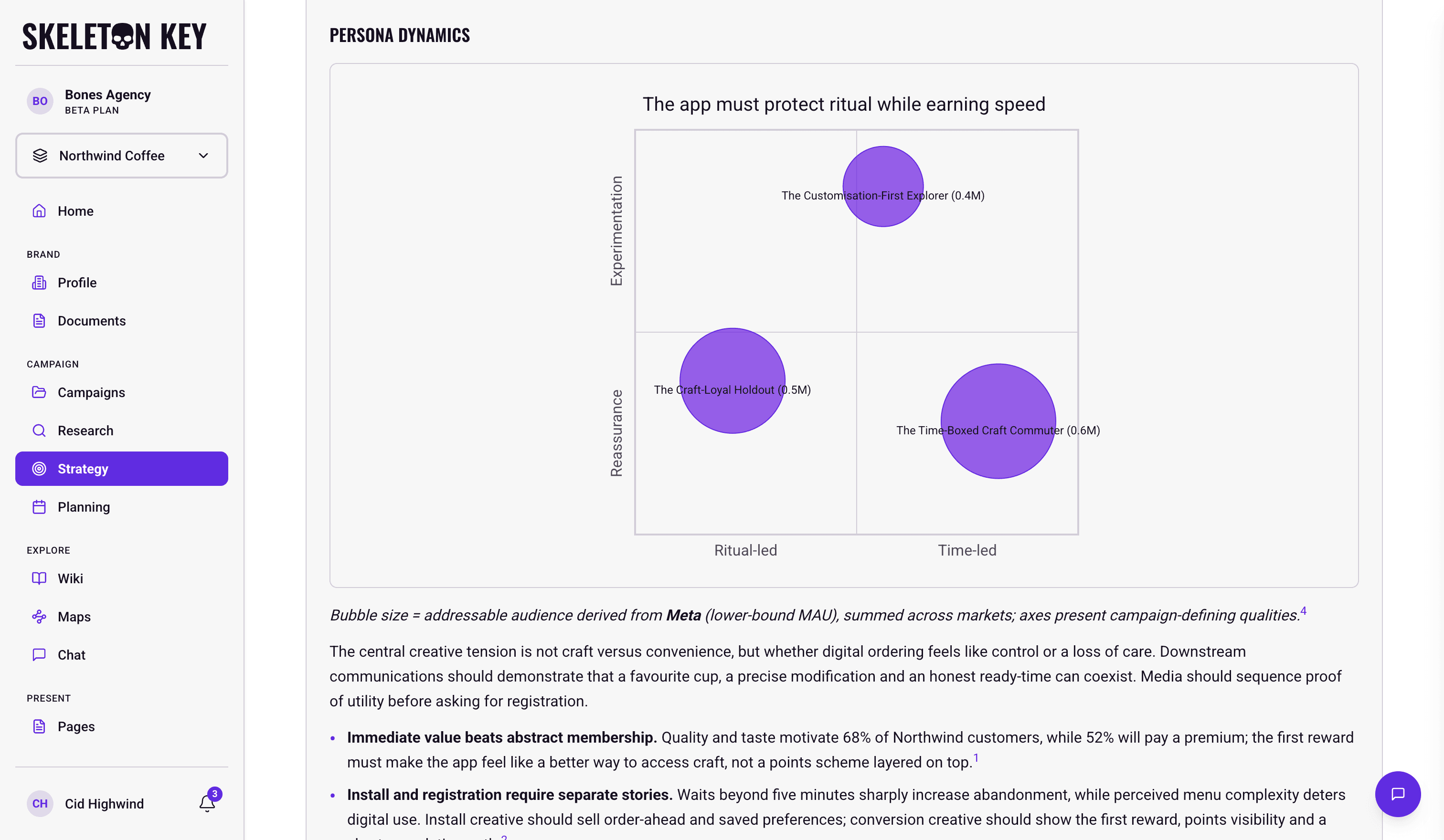
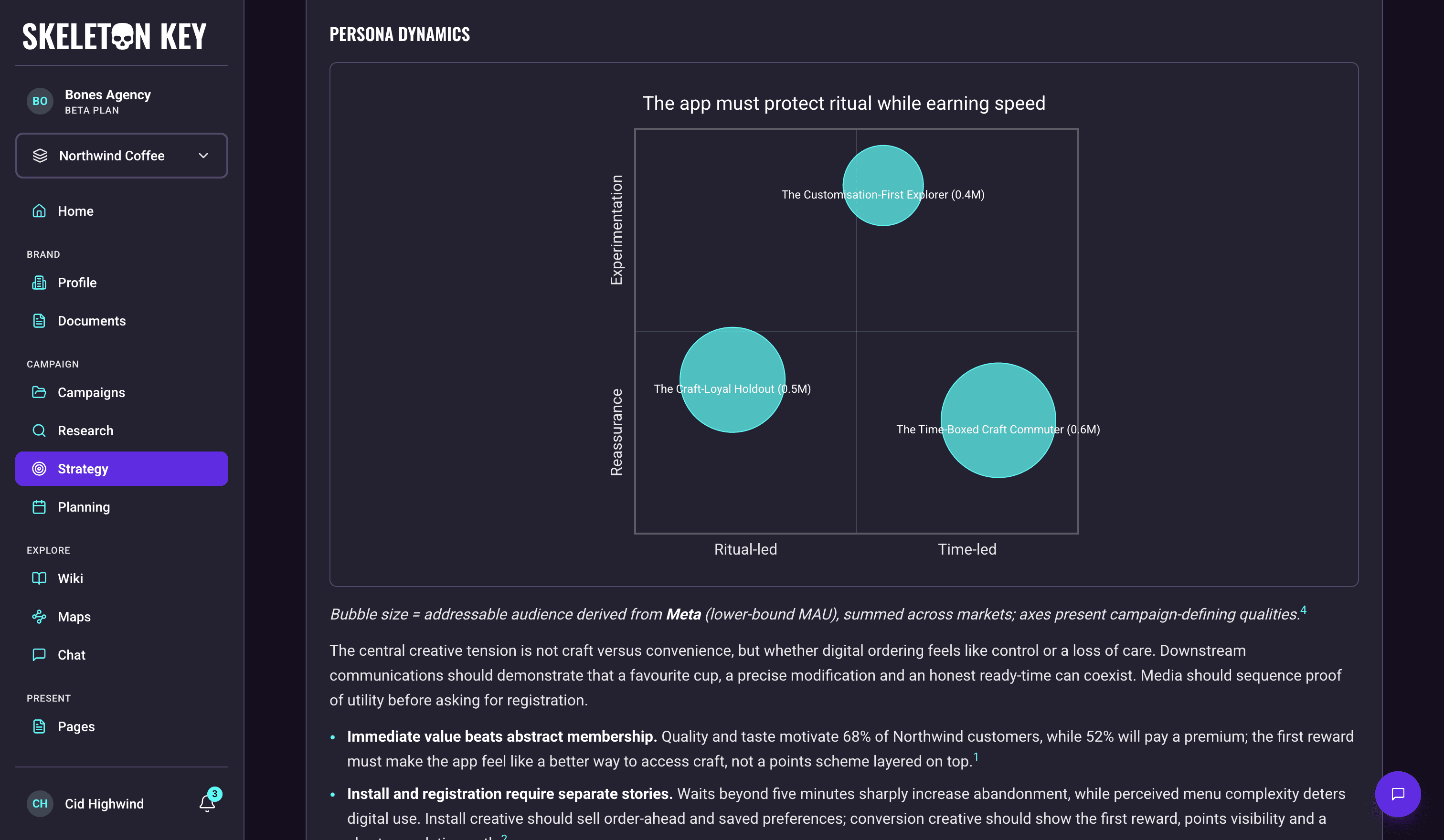
The Audience Strategist is the second of four in the Strategy phase. It turns your Goals output and Research findings into three buyer personas tied to your Key Results, and grounds each persona's reach in empirical audience data: Meta's for B2C campaigns, LinkedIn's for B2B. Communication and Media use the personas as their target definition.
What it does
The Audience output opens with an Executive Read: a short summary of the audience strategy that closes with a persona table. A Personas Overview section follows, sizing the campaign's online addressable audience. Each of the three priority personas is then described in detail.
The overview has two parts:
- Addressable Reach: titled for the platform that sized it (Meta or LinkedIn), it leads with the Audience Sizes table, which breaks reach down by market and persona alongside a Category Reach baseline. Labelled bullets follow: Combined reach (the audience across all personas and every market, counted once per person on Meta), Category coverage (how much of Category Reach the personas cover, and how far they reach beyond it), Distinctness (Meta only: how much of each persona appears in no other persona), Markets (when the campaign has two or more markets: the pattern across them), and one or two strategic reads on what the sizing means for the campaign. For a B2C campaign, reach numbers are lower-bound monthly active audiences sized using Meta's audience targeting catalogue. For a B2B campaign, they are member totals from LinkedIn's advertising platform.
- Persona Dynamics: a quadrant chart placing each persona on the two tensions that matter most for the campaign, with bubble size proportional to its reach. A short opening read and two or three implication bullets follow, calling out what the chart means for downstream Communication and Media work.
Below the overview, each priority persona has its own section with:
- Job-to-be-Done: an italicised quote in the persona's voice describing what the product does for them
- Profile: four to five bullets covering demographics, psychographics, and lived context, closed by a single KR Alignment bullet naming the primary KR (and any secondary)
- Purchase Triggers & Barriers: a two-column table with three rows, separating the moments that pull a persona in from the resistance that holds them back
- Decision Criteria & Influences: a two-column table with three rows, separating evaluation factors from the people and platforms shaping the decision
A short Strategic Considerations section closes the output with three campaign-relevant strategic notes that span personas and market factors.
Where to find it
Navigate to Strategy inside any brand or campaign (after Research completes). Audience is the second of four tabs.
How it works
The strategists run sequentially. Goals runs first. Audience reads the Goals KR table, then the brand profile, campaign brief, the Category, Consumer, Culture, and Social Research outputs, and attached documents. When a Research report leaves out a figure, period, or source, it can look up the search findings stored behind the Category, Competitor, Consumer, and Culture reports. It then queries the advertising platform that fits the campaign (Meta for B2C, LinkedIn for B2B) to size each persona and the combined campaign audience across the markets the Category Analyst prioritised, as Audience reach sizing explains.
How this differs from the Research Consumer Analyst: The Consumer Analyst maps the audience landscape without reference to campaign goals. The Audience Strategist works from the opposite direction: starting from your KRs, it defines the three personas you need to reach them and sizes them empirically. Consumer Analyst output is one of its inputs.
A full Strategy run takes around 7-8 minutes, and the Audience Strategist takes two to three minutes of that.
Audience reach sizing
For a B2C campaign, the strategist describes each persona as a set of interest, behaviour, and demographic signals from Meta's targeting catalogue and asks Meta for an audience-size estimate per persona in every prioritised market. For a B2B campaign, it defines each persona in professional terms (seniority, job function, industry, company size, job titles, skills) and asks LinkedIn how many members match. Live LinkedIn numbers require your organization to have connected LinkedIn under Integrations. Without a connection, the strategist still runs and estimates the sizes itself.
Once the personas are final, the strategist sizes them together on Meta, which returns the combined reach with each person counted once, each persona's unique share (the people who fall in no other persona), and how many of the combined audience sit inside and outside Category Reach. These figures come from Meta directly rather than from adding or subtracting the table's numbers. A persona whose unique share is under 10% mostly repeats another persona, so the strategist recomposes it once and measures again. If it is still under 10%, it stays, and the Distinctness bullet says so. If the combined figure can't be measured, the Combined reach bullet says so and, where a persona was sized, gives the largest persona's size as a floor.
The combined per-persona size also appears as a Size (Meta) or Size (LinkedIn) column in the persona table that closes the Executive Read, with a Unique reach column beside it on Meta, and the underlying segment definitions for every persona are listed as a citation entry at the bottom of the page so you can audit how each one was sized.
Two notes on how the numbers are built:
- The combined figure is built differently per platform. Meta sizes the three personas as one audience with each person counted once. LinkedIn has no equivalent, so the strategist defines B2B personas so that no member falls into two of them (each pair differs on a trait with one value per member, such as seniority or job function) and adds the three totals together. When your brief forces personas that overlap, the combined figure is shown as "up to" that sum.
- Markets follow Research. The per-market rows mirror the Market Prioritisation table from the Research Category Analyst, including any cluster rows (e.g.,
Miami, Atlantastays as one row).
What you can adjust
Campaign brief specificity: Named KPIs, price points, and audience descriptors sharpen persona backgrounds. Specifying target markets in the brief feeds directly into the reach sizing.
Document attachment: Attach documents from the Documents page before starting a Strategy run. Segmentation studies or CRM exports feed directly into persona backgrounds.
Refine: Use the Refine button after a run to submit feedback. Refining Audience re-runs only this strategist (Communication and Media may also re-run). Prior versions stay in history. See Refine.
Limits and considerations
- Persona count is fixed at three. For very narrow campaigns, the third persona may overlap the second. Review all three before briefing teams.
- KR names follow Goals output exactly. Imprecise Goals KRs produce imprecise persona KR alignment. Refine Goals first if the framing is off.
- Platform reach is a proxy, not a forecast. Whether from Meta or LinkedIn, the numbers are relative scale signals, not a campaign reach plan.
- A market may not size. If the platform can't resolve a city or region (small market, ambiguous name), the Audience Sizes table shows
n/afor that row instead of a number. The Addressable Reach commentary notes when this happens. - Very narrow B2B personas may not return a count. LinkedIn withholds audience counts below its privacy threshold, so a tightly defined persona in a small market can come back without a number.
- Beta software. The persona framework is opinionated. Validate before briefing creative or media partners.
Last updated: 2026-11-02